If you’re planning to begin a career in healthcare, one of the first questions you’ll likely ask is, “How long does a Health Support Services Course take in Kenya?” Understanding the course duration helps you plan your education, finances, and career path more effectively.
A Health Support Services Course in Kenya is designed to provide students with the practical knowledge and essential healthcare skills needed to support healthcare professionals in hospitals, clinics, rehabilitation centres, nursing homes, and other medical facilities. The course combines classroom instruction with practical training to prepare graduates for entry-level healthcare roles.
In this guide, you’ll learn about the typical course duration, what influences the length of training, the skills you’ll gain, and the career opportunities available after graduation.
How Long Is a Health Support Services Course in Kenya?
The Health Support Services Course Duration in Kenya varies depending on the training institution, the curriculum, and whether the program includes practical attachment. Most certificate programs can be completed within six to twelve months, with time allocated to both theoretical learning and practical skills development.
At Paula Training Institute, the Health Support Services Course is carefully structured to provide a balanced learning experience. Students receive classroom instruction that builds a strong foundation in healthcare principles while also participating in practical sessions that develop real-world patient care and healthcare support skills. This approach ensures graduates are confident and workplace-ready upon completion.
What Will You Learn During the Course?
Throughout the course, students develop the knowledge and practical skills needed to support quality healthcare delivery. Training covers patient care fundamentals, infection prevention and control, workplace safety, basic anatomy and physiology, communication skills, healthcare ethics, medical terminology, record management, and professional conduct.
Students also gain valuable experience in teamwork, problem-solving, and patient interaction, helping them build the confidence required to work effectively in healthcare environments.
Why Does Course Duration Vary?
Although many Health Support Services programs have a similar structure, the duration may differ between institutions. Factors such as the curriculum, amount of practical training, clinical attachment requirements, study schedules, and whether students attend full-time or part-time can all influence how long the course takes to complete. Institutions that emphasize extensive hands-on learning may require additional practical sessions to ensure graduates are fully prepared for employment.
The Importance of Practical Training
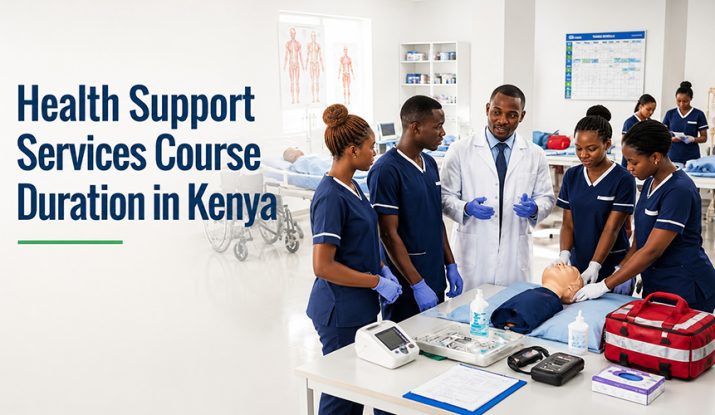
Healthcare is a hands-on profession, making practical experience one of the most valuable parts of the course. During practical training, students apply classroom knowledge in simulated healthcare settings or supervised clinical environments. They learn how to assist with patient care, observe infection prevention procedures, communicate professionally with patients, and support healthcare teams. This practical exposure strengthens confidence, improves technical skills, and prepares graduates for the expectations of real healthcare workplaces.
Career Opportunities After Completing the Course
Completing a Health Support Services Course in Kenya opens the door to a variety of entry-level opportunities within the healthcare sector. Graduates may find employment in public and private hospitals, medical clinics, nursing homes, rehabilitation centres, homecare organizations, diagnostic centres, community health programs, NGOs, and wellness facilities. The course also provides an excellent foundation for further training in specialized healthcare fields such as Caregiving, Healthcare Assistant (CNA), Phlebotomy, Perioperative Theatre Technology, and Occupational Health and Safety.
Why Choose Paula Training Institute?
Paula Training Institute is committed to delivering practical, career-focused healthcare education that prepares students for success in today’s healthcare industry. Our Health Support Services Course combines experienced instructors, modern training facilities, interactive classroom learning, and practical skills development to ensure graduates are ready for employment. We focus on producing competent healthcare support professionals who can make a meaningful contribution to patient care and healthcare service delivery.
Conclusion
Understanding the Health Support Services Course Duration in Kenya helps you plan your journey toward a rewarding healthcare career. While the exact duration may vary between institutions, choosing a program that combines quality classroom instruction with extensive practical training is essential for long-term success.
At Paula Training Institute, our Health Support Services Course is designed to equip students with industry-relevant knowledge, practical healthcare skills, and the confidence to work effectively in diverse healthcare settings. Whether you’re a recent KCSE graduate or looking to start a new career, this course provides an excellent pathway into the growing healthcare sector.
Ready to begin your healthcare career? Contact Paula Training Institute today to learn more about our Health Support Services Course and reserve your place in the next intake.